
Ask a room of healthcare leaders whether they’ve heard of the clinically integrated supply chain, and most hands will go up.
Ask those same leaders to define it, and their answers get more complicated.
For some, clinical integration means bringing physicians into product decisions. For others, it means using clinical evidence to inform sourcing, reduce unnecessary variation, strengthen value analysis, or connect product utilization to patient outcomes.
They are all part of the definition. But none, on their own, is complete.
Today, health systems are looking beyond what they pay for a product to understand something much more difficult: What happens after the purchasing decision is made?
What supplies get used, how often, and for which patients? Does utilization vary across physicians, facilities, or service lines—and is that variation clinically warranted? Most importantly, are those choices producing the outcomes that the organization expected?
These questions sit at the heart of the utilization gap—the distance between the value a health system expects from a purchasing decision and the value realized in clinical practice.
A clinically integrated supply chain can help close that distance.
Integrating the supply chain
At its core, a clinically integrated supply chain brings clinicians, supply chain leaders, and data together to create patient-centric clinical solutions that are grounded in clinical evidence, best practice utilization patterns, cost, and outcomes.
That sounds straightforward, but it’s much harder to operationalize and sustain.
Healthcare organizations have spent years building sophisticated capabilities around contracting, sourcing, value analysis, clinical quality, and analytics, but these capabilities don’t always operate from the same information or toward the same decision.
That disconnect becomes clear when a health system identifies an opportunity to standardize a product and improve practice. Supply chain has visibility into price and contract performance, while value analysis evaluates clinical evidence with total cost to guide product and practice decisions, and clinicians bring an understanding of how and when it should be used. Even when those perspectives lead to a shared decision, the work isn’t finished.
The organization then needs to determine whether practices actually changed and whether that change affected cost, quality, or patient outcomes.
Without that visibility, an organization can’t make a sound decision and will leave much of its potential value unrealized.
The opportunity isn’t just price, but utilization
Visibility is especially important in clinically sensitive categories. Approximately 30-40% of a hospital’s clinical supply expense is associated with physician preference items, where product choice and utilization can depend heavily on clinical practice.
That makes utilization a significant enterprise performance issue.
Price tells leaders what an organization paid, and utilization begins to reveal whether the organization used that resource appropriately.
Answering that question requires connecting information that health systems have historically evaluated separately: spend and pricing, product, formulation, and procedure data, diagnosis and reimbursement, clinical evidence, and outcomes. Clinical integration brings these pieces together around a common question: What does the evidence tell us is the right resource, for the right patient, at the right time—and can we see whether that is actually happening?
That’s where supply chain begins to play a larger role in enterprise performance and clinical solution creation.
From purchasing decisions to clinical decisions
Physicians are being asked to participate in decisions that affect both patient care and the financial health of their organizations, but simply asking clinicians to use a different product or reduce utilization rarely provides enough context to change practice.
The conversation is transformed when clinicians can see the evidence behind the decision, look beyond price to understand differences in outcomes; identify variation across procedures, facilities, and physicians; and compare utilization patterns with clinical evidence and relevant peers.
A clinically integrated supply chain brings those insights together, helping clinicians and operational leaders distinguish necessary clinical personalization from unwarranted variation. It requires strong governance, physician and clinician leadership, robust analytics, clear decision-making processes, and a culture that can translate insight into practice.
What clinical integration looks like in practice
A simple product such as bone cement illustrates how quickly a supply decision can become a clinical utilization question.
Bone cement is commonly used in orthopedic procedures and is available from multiple manufacturers in different formulations. Some formulations contain antibiotics and may be appropriate for particular higher-risk patients. But using them when the clinical circumstances don’t warrant it can add cost without improving outcomes.
A traditional spend analysis might begin with manufacturers, volume, and price. Clinical integration widens the lens to understand how a product moves from selection to utilization to outcome.
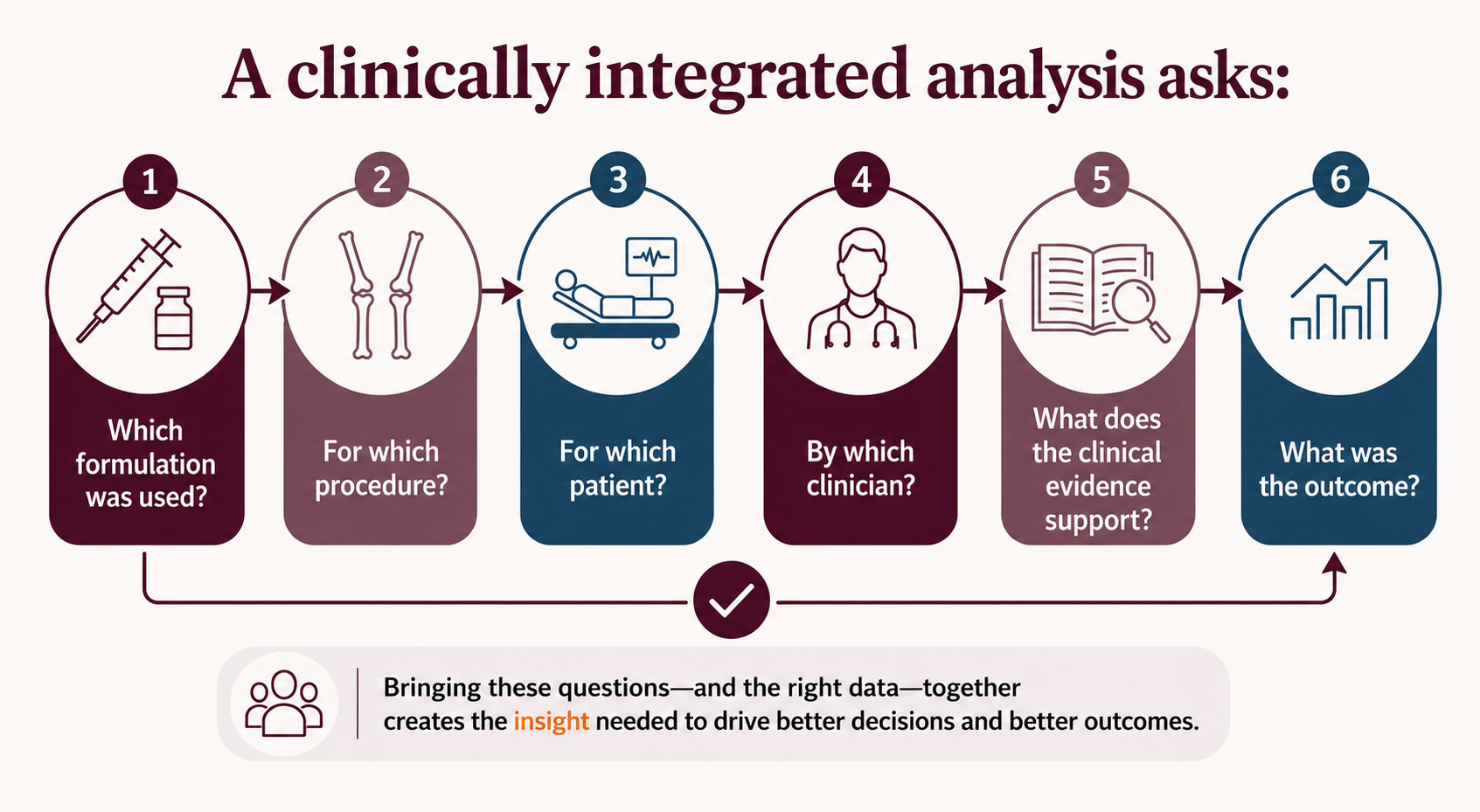
Health systems need to bring together data that’s been historically evaluated separately—including spend, product, pricing, procedure, diagnosis, and reimbursement information—and pair it with clinical evidence and expertise.
Bone cement is just one small example, but the same approach can be applied across all clinical categories where product selection and utilization influence both cost and care.
