In 2020, system leadership tasked the UC Davis Health population health and transitions of care team to improve the experience for complex patients as well as their accountable care contract performance.
Not an easy feat for one of California’s largest academic health systems.
But Dr. Reshma Gupta, MD, chief, population health and accountable care, gathered her team — who she likens to “a small, but nimble and mighty think tank” — to figure out how to best strategize the work ahead, beginning with a gap analysis.
“We wanted to understand how we should bring more clarity to our patient focus — identifying those at highest risk and need — and also how to address care from a staffing perspective,” Dr. Gupta said. “While we had some great pockets of teams doing some of this work throughout the system, we needed to align on standardization, practice, scope and workflow processes so we could work as a unified force.”
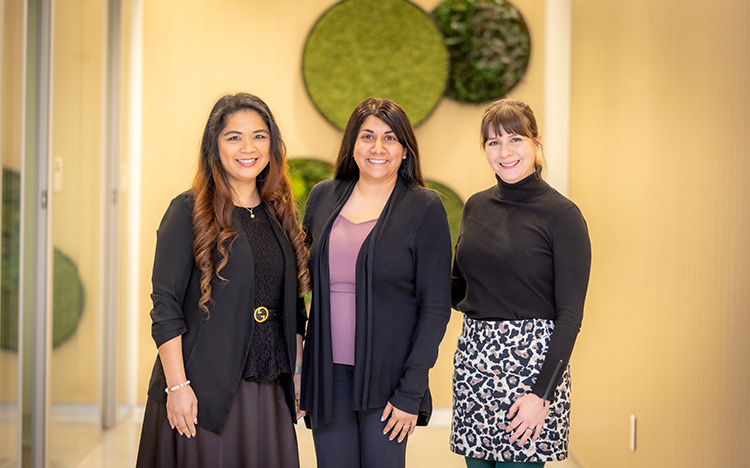
UC Davis Health team from left, Vanessa McElroy, director of care transitions and populations health care management; Dr. Reshma Gupta, MD, chief, population health and accountable care; and Georgia McGlynn, manager, population heath and accountable care. Photo courtesy of UC Davis Health.
Understanding patient needs
The first step was developing a standardized definition of care management across the system. It sounds basic but was key.
“There are almost 20 different terms we use across the organization such as ‘case management,’ ‘care coordination’ and ‘patient navigation,’” said Vanessa McElroy, director of care transitions and populations health care management. “It was important that everyone from executive leadership to department leaders to staff understood the terminology and how care management oversees the entire continuum of patient care and not just a segmented coordination.”
Secondly, they built a care management framework based on clinical acuity and the risk of future acute care utilization to help identify the highest-risk patients and rising risk populations. It’s important to understand both the immediate clinical needs of patients and their risk of future acute care hospitalization as part of their case management framework.
“This nuanced approach allows for a more effective delivery of care management,” McElroy said.
They then implemented tech-enabled, operation and clinical care pathways across the system.
A care management-focused module in their EMR scopes the tasks needed day-to-day for patient care based on inclusion criteria that triggers patient concerns. One of those criteria is a risk model that UC Davis developed using machine learning, which has been successful in predicting future avoidable ED and hospital visits up to 12 months ahead, using a cutoff of 60% for that risk score.
“We use those criteria along with prior utilization in the ED or hospital over the past year and social determinants of health screenings to prioritize the patients,” said Georgia McGlynn, manager, population heath and accountable care. “Additionally, the technology provides a centralized view of the care plan in one place, so care managers know what needs to be done without duplicating the work.”
Care management redesign
In 2021, the team rolled out the first phases of their care management redesign through a series of programs — some existing that were revamped and some new — targeted toward their different risk levels of patients. Their 2024 outcomes speak volumes: 28% lower hospitalization rates in their primary care management program; 33% fewer ICU days through their chronic condition care management program; and 69% of patients with an individual care plan through the multi-visit patients program had reduced visits.
“It’s important to create a vision of care management that doesn’t just occur in primary care or discharge planning in the hospital,” Dr. Gupta said. “If you don’t bridge across the silos, you're never going to reach value-based care.”
Education and retraining were core to the care management model redesign. They worked with interdisciplinary teams across care settings from operations, nursing and pharmacy to social work and the discharge unit.
“We created a team-based model that focuses on care management versus care coordination,” McElroy said, adding that gaining buy-in for change was difficult at times, but the system’s overall culture has boosted making the change possible.
Not only has workplace culture improved, but the care management redesign creates capacity for patients who need hospital care, and the programs build an infrastructure that supports taking on more risk in the future.
“I’m really proud of where we’ve put the gas on the pedal to create results,” Dr. Gupta said. “We’re improving care management with a focus on patients with advanced illness and psychosocial needs, organizing and partnering with multidisciplinary teams, and thinking upstream to address patient social needs.”
